

- Joined
- Jul 11, 2008
- Messages
- 3,018
- Reaction score
- 198
- Points
- 63
For: beginners who want to spot the early traps, build good habits fast, and protect their bankroll from day one.
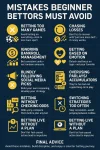
Mistake 1: Betting too many games (activity feels like progress)
The weekend arrives and it feels natural to want action across the board. A bit of football, a bit of basketball, some tennis, a few random leagues, and then live bets because you are already watching. It feels like you are covering yourself, but what you are really doing is spreading your attention so thin that you stop making decisions properly.The real cost is not only that you know less about each match. It is that your standards drop. When you have ten bets open, you cannot explain each one clearly anymore. The process becomes “collecting tickets” rather than buying good prices, which is why the results start to feel random.
The habit that fixes this is boring and effective: pick one main sport and reduce your menu of markets. Fewer bets means you actually remember why you placed them, which is how review becomes useful instead of performative.
Mistake 2: Chasing losses (turning betting into emergency mode)
Chasing nearly always begins with a sentence that sounds reasonable in your head: “Just one more to get back to even.” But the moment you think like that, the goal changes. You are no longer trying to make a good decision at a good price, you are trying to repair your mood.This is why chasing is so destructive. You start raising stakes after a loss, you take bets you would normally pass, you switch sports because you want something “quick”, and live betting becomes the perfect escape hatch because it feels like you can fix the day in real time.
The solution is not a clever bet. It is a stop rule you follow even when you do not feel like it. If you feel urgency, desperation, or that heavy need to “win it back”, you are not in a decision state. Close the app, reset, come back later with your normal unit size and normal standards.
Mistake 3: Ignoring bankroll management (random stakes create guaranteed chaos)
Many beginners stake in a way that has no pattern: a small amount here, a bigger amount there, then a huge amount on a “sure thing”. The outcome is predictable. Variance becomes violent, and you never learn anything because your results are driven by stake swings, not decision quality.Bankroll management is simply the agreement you make with your future self that you will not let emotions set the stake. A consistent unit does that. It keeps you alive during normal losing runs, and it makes your results readable enough to improve.
If you want one practical rule: keep your usual stake small and consistent. The aim is not to feel brave, it is to survive long enough for learning to compound.
Mistake 4: Betting with emotion (fandom is not analysis)
Backing your favourite team because you love them is not strategy. Betting against a team you hate is not strategy either. Emotion does one thing extremely well: it makes you accept bad prices because you care about the outcome.The tricky part is that emotion often disguises itself as “confidence”. You tell yourself you have a strong read, but really you just want the bet to win. Then you notice only the information that supports your desire, and you ignore the stuff that should make you cautious.
A simple self-test helps: if you would feel personally annoyed or relieved by the result, you are probably too emotionally involved to price it fairly. That does not mean you can never bet those teams. It means you need stricter standards and smaller stakes when you do.
Mistake 5: Blindly following social media picks (outsourcing thinking is expensive)
The internet is full of tipsters who sound confident and show highlight reels. Many do not track properly, many sell parlays because big slips look impressive, and some are simply marketing. Even the honest ones do not solve your core problem: copying teaches you nothing unless you understand why the bet is value and when it stops being value.If you are serious about improving, you need your own reasoning. It does not have to be advanced. It just has to be consistent and reviewable. If someone cannot show long-term results clearly, assume it is entertainment and treat it accordingly.
Mistake 6: Overusing parlays (the maths is not on your side)
Parlays feel like progress because they turn small stakes into exciting payouts. The problem is that each extra leg adds another way for the slip to die, and beginners often add the weakest leg last, the one that exists purely so the payout looks nicer.That pushes you into brutal variance. Long losing streaks become normal, which then feeds the next mistake: chasing and emotional staking. Parlays are not evil, but they are a rough foundation for learning because they hide whether your picks were actually good.
If you use parlays, treat them as entertainment with tiny stakes. If you want to build skill, singles are where you learn to judge price and decision quality.
Mistake 7: Not checking odds (you pay a hidden tax)
A small difference in price looks harmless, but over time it is real money. More importantly, checking odds trains the correct mindset. You are not trying to prove you are right. You are trying to buy a good number.Beginners often pick an outcome and then accept whatever odds they see first. That is like walking into a shop and paying the first price tag without checking the next shelf. You do not need to obsess over every decimal, but you should build the habit of comparing before you commit, especially on common markets.
Mistake 8: Misunderstanding variance (panicking after normal losing runs)
Sport is noisy. Late goals, penalties, red cards, deflections, one mistake, one moment. These things happen constantly, which means losing streaks happen even when your decisions are fine.Beginners often interpret a few losses as “the strategy is broken”, then they switch approach, change stakes, or start forcing riskier bets to feel in control again. That is usually how a stable bankroll becomes unstable.
The skill is separating decision quality from outcome. A good bet can lose. A bad bet can win. If you judge yourself on one weekend, you will keep changing things at the worst time.
Mistake 9: Switching strategies too often (drifting is not adapting)
A common beginner loop looks like this: favourites for a week, underdogs next week, parlays after that, then live betting, then someone posts a system and you try it too. It feels like learning, but it is usually chasing certainty.Real improvement is slower and less dramatic. You pick a simple approach, you run it long enough to gather real feedback, and you adjust based on evidence rather than vibes. If you are constantly switching, you never get a clean sample, so you never really learn what works for you.
Mistake 10: Live betting without a plan (speed turns feelings into bets)
Live betting is tempting because it feels like control. In reality, it is where beginners make the fastest emotional bets because the app is built for speed and the clock creates urgency.If you want to live bet as a beginner, you need one clear rule: you only bet when you can explain what changed in the match and why the price has not caught up. If you cannot explain that in one calm sentence, you are not missing a chance, you are avoiding a mistake.
The pattern behind almost every beginner mistake
Most beginner mistakes are the same mistake wearing different clothes: betting to feel something now instead of making a priced decision. Once you see that, the fixes become clearer. You do not need to become a genius overnight. You need fewer emotional decisions.A real beginner upgrade is not “smarter picks”. It is fewer impulse bets, steady stakes, and a process you can repeat on good days and bad days.
Putting it all together
If you avoid these traps, you end up ahead of most new bettors immediately. Betting becomes calmer and easier to learn because your bankroll stops swinging wildly, your decisions become repeatable, and your review starts telling you the truth.Start by betting less, staking consistently, and keeping markets simple. Track what you do. Accept variance. Improve slowly, based on what your results actually show.
Checklist (use this when you feel yourself drifting)
- Am I betting because I have a clear reason, or because I want action?
- Is my stake my normal unit, or am I trying to fix a feeling?
- Can I explain the bet and the price calmly in one sentence?
- If this loses, will I accept it without rushing to place another?
FAQ
Q1: What is the biggest beginner mistake?Chasing losses, because it turns normal variance into bankroll destruction.
Q2: How many bets per day is safe for beginners?
Fewer than you think. Only bet when the decision is clear enough that you could explain it calmly the next day.
Q3: When should I start using more advanced markets?
After you are consistent in simple markets and your staking does not drift with mood.
Next in Beginner Series: The Beginner’s Guide to Value Betting
Previous: The Safest Betting Markets for Beginners
Attachments
Last edited:

 Beginner Betting Guides - Reference Menu


