

- Joined
- Jul 11, 2008
- Messages
- 1,670
- Reaction score
- 184
- Points
- 63
For: beginners who want value explained in plain English, how to spot it in real markets, and which traps to avoid early.
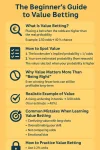
What value betting actually is
Value betting is not a special type of bet. It is a reason for a bet. You place a value bet when the odds are higher than they should be for the true chance of the outcome.A useful way to picture it is shopping. The bookmaker is offering you a price tag. Your job is deciding whether that price tag is generous or stingy. If the true chance is bigger than what the odds imply, you are being overpaid for the risk. That is value.
This is the part beginners must get comfortable with: value does not mean “this will win”. It means “this is a good deal”. A good deal can still lose today, just like a good stock can drop this week. The edge shows up over repetition, not over a single match.
So stop framing bets as “I think this happens”.
Start framing them as “I think this price is wrong in my favor”.
The simplest way to spot value: compare two probabilities
You only need two numbers:what the odds imply, and what you honestly think the chance is.
With decimal odds, the shortcut for implied probability is:
implied probability ≈ 1 / odds
So 2.00 implies about 50%. 1.80 implies about 55.6%. 3.00 implies about 33.3%. You do not need to be perfect with the decimals. You just need to be roughly right often enough to make good decisions.
Then you make your own estimate of the real chance. Not a fancy model, not an ego number. An honest percentage based on information you understand.
Now the rule becomes very plain: if your estimated chance is meaningfully higher than the implied chance, the bet may be value. If it is the same or lower, you pass. Everything else in betting is just improving your estimates and getting better at when to trust them.
Why value matters more than “being right”
Beginners often judge themselves by wins and losses because it is emotional and it is immediate. The problem is that win rate alone does not decide profit. Price does.You can win a lot of bets and still lose money if you keep taking short odds that are not worth it. You can also win less often and still profit if your prices are consistently too generous. This is why experienced bettors care about odds movement, line shopping, and whether their bet looked like a good number later. They are not trying to be correct as often as possible. They are trying to be paid correctly.
Once you accept that, your betting becomes calmer. Losing a value bet does not feel like a personal failure. It feels like a normal outcome of a good decision in a game with variance.
A realistic example (value is often uncomfortable)
Imagine an underdog priced at 3.50. The implied probability is about 28.6%. You do your homework and you believe their true chance is closer to 40% because the matchup suits them, the opponent has a minor limitation, and the conditions favor the underdog’s strengths.Even if you are right, that underdog still loses more often than it wins. You will have losing runs. That is not evidence you were wrong. It is evidence you are betting something that is supposed to lose a lot but pays you enough to be worth it.
This is the mental shift: value is about being overpaid, not about feeling safe. If you need comfort, you will overbet favourites at bad prices and call it “smart”. Markets love that version of the beginner.
How to estimate probability without pretending you are a model
Beginners get stuck because they think value betting requires statistics wizardry. It does not. It requires consistency.Pick a small set of inputs you can apply repeatedly. In football, it might be chance quality, tactical matchup, and likely match script. In basketball, it might be pace and shot profile. In tennis, serve and return strength plus surface fit. The specific inputs matter less than using the same ones every time, because repetition is how your calibration improves.
Where beginners go wrong is changing their reasoning every bet. One day it is “form”. Next day it is “motivation”. Then it is “they looked sharp”. If your logic shifts constantly, your percentage is not a probability estimate, it is a story your brain wrote to justify action.
The four traps that ruin value betting early
New bettors usually fail at value betting for predictable reasons, and most of them are psychological rather than mathematical.First, they confuse high odds with value. Big payouts are not value if the true chance is even smaller than the odds imply. Second, they overestimate their skill and treat early wins as proof. Your first estimates will be noisy, so stakes must stay small while you learn. Third, they do not compare odds. Value often exists only at the best number available, and a small difference in price can be the whole edge. Fourth, emotion contaminates the estimate. If you want a team to win, your percentage quietly turns into fantasy.
If you avoid those four, you are already ahead of most beginners who say they are “value betting” while actually just chasing prices that look fun.
A beginner routine that trains price sense (without overcomplicating it)
If you want to build the skill fast, you need a repeatable routine you can stick to.Start by focusing on one sport you actually follow, because random sports lead to random estimates. Before you look at odds, write a rough probability for the outcome you are considering. Then check the odds and convert them to implied probability. Only consider a bet if your estimate is meaningfully higher, not just a tiny difference you could talk yourself into. Finally, track it: odds taken, your estimated probability, and one sentence on why you believed the chance was higher.
That one habit does more for your long-term results than watching endless picks content, because it trains the exact muscle that matters: judging whether a price is worth buying.
Bankroll rules that let the edge show up
Even strong value can lose in the short term, especially if you bet underdogs or anything above even money. This is why bankroll discipline is not a separate topic from value betting, it is part of it. If you stake too big, variance forces you to quit or chase before the math can work.Keep stakes small and consistent. Do not increase after losses. Track everything. Expect losing streaks and do not treat them as proof the method is broken. If you judge value betting by one weekend, you will quit at the exact moment the edge would have started to show over time.
Putting it all together
Value betting gives you a real rule you can follow: if the odds are higher than they should be for the true chance, you bet. If the odds are fair or too low, you pass.Your job as a beginner is not to be perfect. Your job is to estimate honestly, compare it to the implied chance, shop for the best number, and stake small enough that you can survive the normal swings. Do that consistently and you are already thinking like a serious bettor, even with beginner-level knowledge.
FAQ
Q1: Is value betting the same as picking underdogs?No. Value can exist on favourites or underdogs. It is about price versus true chance, not about big odds.
Q2: What if my estimate is wrong?
It will be sometimes, especially early. The goal is to improve calibration over a real sample while keeping stakes small enough to learn safely.
Q3: How often will value bets lose?
Often. Even great value can lose short-term. Profit comes from repeating good prices over many bets, not from expecting every “value bet” to win.
Next in Beginner Series: How to Choose the Right Bookmaker as a Beginner
Previous: Mistakes Beginner Bettors Must Avoid
Attachments
Last edited:

 Beginner Betting Guides - Reference Menu
 .The whole “you are hunting prices, not winners” thing makes sense in my head, but I still get stuck on the “your estimated probability” part. Like… how do you not just end up making up a number because you want the bet?
