

- Joined
- Jul 11, 2008
- Messages
- 2,855
- Reaction score
- 198
- Points
- 63
For: beginners who want to understand odds quickly, calculate payouts, convert between formats, and pick the best display for their betting style.
What odds actually mean (one simple idea)
No matter how they’re written, odds answer two questions:How much do I win if I’m right?
What chance is the market implying?
Higher odds mean bigger payout, but a lower implied chance.
Lower odds mean smaller payout, but a higher implied chance.
The key mental shift is this:
Odds are a price. You are not picking teams, you are deciding whether the price is worth the risk.
Decimal odds (Europe/Asia standard)
Decimal odds are the simplest for beginners because they show your total return per 1 unit staked, including your stake.Example: 2.50
If you stake 10, your total return is 10 × 2.50 = 25.
Your profit is 25 - 10 = 15.
So the quick rule is:
Total return = stake × decimal odds
Profit = stake × (decimal odds - 1)
A quick feel for decimals:
1.50 feels like a strong favourite
2.00 is close to even
3.00+ is an underdog
Implied probability is also easy:
Implied chance ≈ 1 / decimal odds
2.00 is about 50%
1.50 is about 66.7%
4.00 is about 25%
You do not need this for every bet, but it is a great “sanity check” when you feel tempted by a price.
Fractional odds (UK/Ireland tradition)
Fractional odds show profit relative to stake. The fraction is profit over stake.Example: 5/2
You win 5 units profit for every 2 units staked.
If you stake 10:
First scale the fraction to your stake. 10 is five times 2, so profit is five times 5.
Profit = 25
Total return = profit + stake = 25 + 10 = 35
“Evens” is 1/1, meaning you profit 1 for every 1 staked.
Implied probability for fractional odds:
denominator / (numerator + denominator)
For 5/2:
2 / (5 + 2) = 2/7 ≈ 28.6%
Fractional odds can feel natural if you grew up with them, but beginners often trip because they look at the top number and forget the bottom is the risk side of the ratio.
American odds (US sports standard)
American odds use + and - signs around 100 and are built around profit on 100, or stake needed to win 100.+200 means: stake 100 to win 200 profit (total return 300)
If you stake 10 instead, you win 20 profit (total return 30)
-200 means: stake 200 to win 100 profit
If you stake 20 instead, you win 10 profit (total return 30)
Implied probability:
For +odds: 100 / (odds + 100)
Example +150:
100 / (150 + 100) = 100/250 = 40%
For -odds: |odds| / (|odds| + 100)
Example -150:
150 / (150 + 100) = 150/250 = 60%
American odds are great if you think in “risk vs reward” naturally, but they confuse beginners when switching between plus and minus quickly during live betting.
Fast conversion (the only ones you really need)
You do not need to memorise 20 formulas. These four cover most situations.Decimal to fractional:
decimal - 1 (then write as a fraction)
Example 2.50:
2.50 - 1 = 1.50 = 3/2
Fractional to decimal:
(numerator / denominator) + 1
Example 5/2:
5/2 = 2.5, plus 1 = 3.5
American to decimal:
If +odds: (odds / 100) + 1
Example +180:
180/100 = 1.80, plus 1 = 2.80
If -odds: (100 / |odds|) + 1
Example -200:
100/200 = 0.50, plus 1 = 1.50
Once you can convert to decimal in your head, you can compare prices across any format without stress.
Which odds format should you use?
Use the format that makes you fastest and least emotional.Most beginners should start with decimal because both payout and implied chance are more direct.
Fractional is comfortable if you learned betting through UK/Irish culture, especially racing.
American makes sense if you mainly bet US sports and naturally think in + and -.
The good news is that most platforms let you change the display in settings, including Everygame, Everygame, 1xBet, and MadMarket. Changing the format does not change the bet, it only changes how the same price is shown.
Beginner reality check (tiny pre-bet routine)
- Can I explain why I like this bet in one sentence?
- Do the odds imply a chance lower than my honest estimate?
- Is the payout worth the risk, or am I just backing a favourite because it feels safe?
This keeps odds as a decision tool, not decoration.
Common odds traps beginners fall into
- Thinking low odds are “safe” - they are only safe if the price is fair.
- Chasing big odds because the payout looks exciting - value matters more than size.
- Mixing formats mid-session and getting confused - pick one display and stick to it.
A good bet is not “the most likely winner.” A good bet is the best price relative to the real chance.
Putting it all together
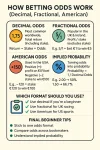
Odds are just different languages for the same message.Decimal shows total return.
Fractional shows profit ratio.
American shows profit per 100 (or stake needed to win 100).
Learn one format deeply, know how to convert the others, and get into the habit of translating odds into implied probability in your head. Once you do that, you stop betting on teams and start betting on prices - which is the foundation of every serious bettor.
FAQ
Q1: Do different odds formats change my winnings?No. The bet is identical. Only the display changes.
Q2: What’s the easiest format for beginners?
Decimal odds, because payout and implied chance are most direct.
Q3: How do I know if odds are good value?
If your honest probability is higher than the implied probability from the odds, you may have value. If not, pass.
Next in Beginner Series: How to Manage Your Bankroll (Beginner Edition)
Previous: Beginner Betting 101 - The Absolute Starter Guide
Attachments
Last edited:
 Beginner Betting Guides - Reference Menu
