

- Joined
- Jul 11, 2008
- Messages
- 2,825
- Reaction score
- 198
- Points
- 63
The guide is for anyone betting NFL spreads who doesn't understand why moving from -2.5 to -3.5 costs more than moving from -4.5 to -5.5. What key numbers are, why they exist, and how to use them without overthinking it.
What key numbers actually are
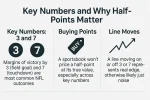
A key number is a final margin that occurs more frequently than the numbers around it. In the NFL, games land on 3 and 7 far more than any other margins because of how football scores.Field goal is 3 points. Touchdown is 7 points including the extra point. Those are the two most common scoring plays. That means games end with one team winning by exactly 3 or exactly 7 more often than winning by 2, 4, 5, 6, 8, or almost any other number.
Decades of NFL results show this clearly. Roughly 9% of games land on exactly 3 points. Roughly 9% land on exactly 7 points. The next most common margins are 10, 6, 4, and 14, but none of them come close to 3 and 7.
This isn't theory. It's just how football works. A team kicks a field goal and wins by 3. A team scores a touchdown and wins by 7. These margins happen constantly. Other margins require multiple scores or specific combinations. They're less common.
Why key numbers change everything about pricing
Books know the key numbers. They price them accordingly.If a spread moves from -2.5 to -3, you're crossing a key number. That line is now more valuable to the underdog because a field goal margin pushes instead of losing. Books charge for that. You'll see -3 at -115 or -120 instead of the standard -110.
If a spread moves from -6.5 to -7, same thing. Touchdown margin now pushes. Books charge extra. If a spread moves from -7 to -7.5, you're moving off a key number. Books might offer better juice on the -7.5 because they're less worried about landing exactly on 7 with that number.
The key number tax is real. You pay for crossing 3 and 7. You save slightly for moving away from them. People who don't understand this just see numbers moving and don't realize why the price changes.
The full key numbers list
3 and 7 are the big two. After that it drops off but these still matter.Primary key numbers: 3, 7
Secondary key numbers: 10, 6, 4, 14
Why these matter:
- 3: field goal
- 7: touchdown
- 10: field goal plus touchdown
- 6: two field goals
- 4: touchdown with missed extra point, or field goal plus safety
- 14: two touchdowns
After 14 the frequency drops significantly. Margins like 17, 20, 21 happen but they're not key numbers in the same way. You don't need to memorize the whole list. Just know that 3 and 7 are the ones that change pricing the most.
When buying points makes sense
Buying points means paying extra juice to move the spread in your favor. Most books let you buy a half-point or full point for -120, -125, or -130 depending on the number.This is almost always a bad bet except when crossing 3 and 7. The math doesn't work otherwise. You're paying too much for numbers that don't hit frequently enough to justify the cost.
When it makes sense: buying from -3.5 to -3, or from +2.5 to +3. You're paying to get the push on a field goal margin instead of losing. That's worth it because 3 hits so often. Buying from -7.5 to -7 or from +6.5 to +7 works the same way for touchdown margins.
When it doesn't make sense: buying from -4.5 to -4, or from -5.5 to -5, or really anything that's not crossing 3 or 7. You're paying -120 or worse to move off numbers that barely matter. That's just giving the book extra juice for nothing.
I see people on the forum buying points on every bet because it "feels safer." It's not safer, it's more expensive. The only time you should be buying is when you're crossing a key number and even then you need to ask if the bet is actually good or if you're just forcing it.
How to read line moves around key numbers
When a line moves, the key numbers tell you if it's meaningful or just noise.Big line move: The spread opens Chiefs -7.5 and moves to Chiefs -9. That's a full 1.5 points. It jumped over a key number (7) and then moved further. That's sharp money or significant injury news. The market is repricing the game substantially.
Small line move crossing a key: The spread opens Chiefs -6.5 and moves to Chiefs -7.5. Only one point but it crossed 7. That matters. The book is now offering the Chiefs laying more than a touchdown. They wouldn't do that without reason - either the public is hammering the Chiefs or sharp money came in.
Small line move not crossing a key: The spread opens Chiefs -4 and moves to Chiefs -4.5. Half a point, no key number crossed. This is probably just balancing action or minor adjustments. Not meaningful.
Line stuck on a key number: The spread opens Chiefs -3 and stays there all week. The book doesn't want to move off 3 because moving to -3.5 makes the Chiefs less attractive and moving to -2.5 makes them too attractive. They'd rather adjust the juice to -115 or -120 and keep it on 3. When lines get stuck on key numbers, that tells you the number is exactly where the sharp money thinks it should be.
When a line move is real edge versus noise
Not every line move means something. Most are just books balancing action between casual public money. The moves that matter are the ones that cross key numbers or move multiple points.Real edge signals: Line moves 1.5+ points in either direction. Line crosses 3 or 7 and keeps moving. Line moves quickly after news drops (injury, weather). Line moves the opposite direction of public betting percentages - if 70% of bets are on the Chiefs but the line moves toward the opponent, that's sharp money disagreeing with the public.
Noise signals: Line moves a half-point and stops. Line bounces back and forth between -3 and -3.5 or -7 and -7.5. Line moves slowly over several days with no news. These are just the book managing action, not the market repricing the game.
The mistake people make is chasing every line move. They see it move from -6 to -6.5 and think "sharp money came in, I need to bet now." That's not how it works. Most moves are balance moves. The real moves are obvious - full points, crossing keys, speed of change.
Teasers and key numbers
This is where key numbers become most valuable. A 6-point teaser lets you move spreads 6 points in your favor across multiple games.The value comes from moving through key numbers. Taking a -8.5 favorite down to -2.5 crosses both 7 and 3. That's legitimate value because you're protecting yourself on the two most common margins. Taking a +1.5 underdog up to +7.5 crosses 3 and 7 the other way. Also valuable.
Taking a -1.5 down to +4.5 crosses 3 but nothing else. Less valuable. Taking a -13 down to -7 crosses nothing meaningful - you're using 6 points to move between irrelevant margins. That's wasting the teaser.
Wong teasers - named after Stanford Wong who wrote the book on this - focus on moving through key numbers with reasonable favorites and underdogs. Tease dogs from +1.5 to +2.5 up to +7.5 to +8.5. Tease favorites from -7.5 to -8.5 down to -1.5 to -2.5. Anything outside that range usually isn't worth teasing.
Teasers are exploitable if you use them correctly. They're traps if you tease random numbers or tease totals. The key number concept doesn't apply to totals the same way. Don't tease totals. Don't tease heavy favorites or big dogs. Tease through 3 and 7 with spreads in the sweet spot.
Common key number mistakes
- Buying points on non-key numbers - paying -120 to move from -5.5 to -5 is just giving away money
- Not buying when it matters - having Chiefs -3.5 when you could buy to -3 at -120 and get the push protection
- Treating all line moves as signals - most half-point moves are noise, not information
- Ignoring juice changes - if the line stays at -3 but moves from -110 to -120, that's the book telling you where the action is
- Teasing through irrelevant numbers - using 6 points to move a -12 to -6 crosses nothing that matters
- Forcing bets because a key number is available - just because a spread is exactly -3 doesn't make it a good bet
When to actually care about key numbers
You don't need to obsess over this. Key numbers matter in specific situations.Care about them when deciding whether to buy points. If you're not crossing 3 or 7, don't buy. Care about them when reading line moves. Big moves that cross keys are information. Small moves that don't cross keys are usually noise. Care about them when building teasers. Moving through keys is the entire point of teasing.
Don't care about them when making your initial handicap. Figure out what you think the margin will be first, then check if key numbers give you an advantage. Don't reverse-engineer your opinion to fit key numbers. That's backward.
Realistic scenario
You think the Chiefs beat the Broncos by 5-6 points. A field goal and a field goal, or a touchdown and they give up a field goal late. The spread is Chiefs -6.5 at -110.Should you bet it? Should you buy to -6? Should you wait and see if it moves?
The spread is a half-point off the key number (7). If you buy to -6 you're paying -120 or worse and you're not crossing a key - 6 is not a key number. If you buy to -5.5 or -5 you're moving further from 7 and just burning money on juice.
The play is either bet -6.5 at -110 or don't bet at all. If you think they win by 5-6, laying 6.5 is reasonable. You're giving up the 6-point margin but that's less common than 7 anyway. If it moves to -7 or -7.5, it crossed the key and you probably missed the best number. If it moves to -6, you saved a half-point but that's not a key so it barely matters.
After the game, write down the final margin and whether it hit a key number. Over time you'll see how often 3 and 7 actually show up versus how often random margins like 5, 8, 11 show up. That's how the key number concept becomes real instead of just theory.
FAQ
Are there key numbers for totals?Not really. Some books will tell you 37, 41, 44 are slight key totals because of common scoring patterns, but the effect is much weaker than spreads. Don't buy points on totals and don't tease totals. The key number concept is mainly for spreads.
Should I always bet when the spread is exactly on 3 or 7?
No. A spread being on a key number doesn't make it a good bet. It just means if you do bet it, you're getting push protection on the most common margin. You still need to have an actual reason to think one side covers. Key numbers are about price and probability, not handicapping.
What if the spread is -2.5 or -7.5, just off the key?
That's often better value if you're betting the favorite. You're getting a half-point for free because the book is less worried about landing exactly on the key with the .5 hanging out there. If you're betting the dog, you'd prefer +3 or +7 to get the push protection. But again, don't let the key number override your actual opinion on the game.
Attachments
Last edited:


