

- Joined
- Jul 11, 2008
- Messages
- 3,023
- Reaction score
- 198
- Points
- 63
For: new bettors who want a safe starter menu of markets, why they are safer, and which traps to avoid early.
What “safe” actually means in betting
No market is safe in the sense of guaranteed wins. When people say “safe” in betting, what they usually mean is safer for learning. The bet has clear rules, the outcome is easy to understand, and when you lose you can actually review the decision without needing a dictionary of settlement quirks.That matters because beginners are not only learning sport, they are learning decision-making. The market you choose either helps that learning or hides it. Complicated bets can create a terrible feedback loop where you lose, feel unlucky, and never really understand whether the bet was smart or just a coin flip with fancy packaging.
So the aim is to start with markets where you can explain the logic clearly, and where your results teach you something useful about your process.
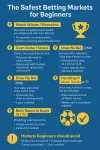
Match winner (moneyline) - simple rules, honest feedback
Match winner is the cleanest bet you can place: you are backing one side to win. It is not “safe” because favourites always win. It is safe for learning because it forces the core habit that matters in every market: price versus chance.If you take a price that is too short, you can be right and still be making a bad bet long-term. If you take a fair price, you can lose and still have made a good decision. Match winner makes this lesson obvious, which is exactly what you want early.
The common beginner trap here is treating favourites as safe. A favourite is only safe if the price is generous, and often it is not. Beginners get seduced by “likely to win” and forget that “worth betting” is a different question.
Totals (Over/Under) - a great market when you can explain pace and chances
Totals remove one stress point: you do not need the correct team, you need the correct type of match. That is a big reason they are beginner-friendly. You can misread who wins but still read the game environment correctly.A totals bet becomes sensible when you can describe why scoring should be higher or lower than the line suggests. Not “these teams always score”, but a real reason rooted in how the match is likely to be played: tempo, chance quality, defensive styles, key absences, weather, or the kind of game state both teams are comfortable with.
The trap is betting totals purely off stereotypes. People love default narratives like “both teams attack” or “this is a derby so it will be crazy”. Markets know those stories too, which means you are usually paying for the obvious version. If you cannot explain why the price is wrong rather than why goals might happen, you are probably forcing it.
Double chance (football) - useful training wheels, but only if you respect the price
Double chance lets you cover two results, which reduces how often you lose. That can be genuinely helpful for beginners because frequent losses are what trigger chasing. It also teaches a healthier habit: thinking in outcomes that fit your read rather than needing a perfect prediction.The trade-off is that you pay for the insurance with lower odds. That is not a problem if you understand you are buying protection, not printing profit. Where beginners go wrong is using double chance to justify weak reads. Protection does not turn a bad bet into a good bet, it just changes how often it hurts.
Draw No Bet (DNB) / Asian Handicap 0 - the cleanest “protection” bet in football
DNB and AH 0 are simple once you understand the shape: you pick the side you think is better, but if the match ends in a draw your stake is refunded. This is one of the best beginner stepping stones because it introduces the concept of a push without throwing you into confusing handicap math.It is especially useful when your read is “this team is stronger, but the match could easily draw”. In those spots, DNB is a practical way to express your opinion without pretending the match is more one-sided than it is.
The learning benefit is that it teaches you to match your bet to your confidence level, which is a skill more important than any single prediction.
BTTS (football) - simple yes/no, but not the same as “goals”
Both Teams To Score looks beginner-friendly because it is a clean question: do both teams score at least once? It can be a reasonable starting market when your reasoning is also clean, meaning both teams have a realistic route to chances and are likely to spend time in dangerous areas.Where beginners mess it up is treating BTTS as a lazy goals bet. A match can have goals and still be one-sided. A match can be lively but have one team with no real threat. BTTS needs two functioning attacks, not just a high shot count or a popular narrative.
If you cannot explain why the weaker side is likely to score, you are usually guessing.
Broad props (use sparingly) - simple outputs, but watch the hidden margin
Props become dangerous when they get specific, but broad props can be okay for beginners if you keep them simple and you are strict about price. The idea is that you are isolating one straightforward output rather than predicting the whole match.Team over 0.5 goals is a good example because you are asking, “Will they score once?” rather than “Will they win?” Team totals can also make sense when your read is about one side’s ability to create rather than the match outcome.
The warning is that props often carry extra margin and can be priced less efficiently, so “broad” does not automatically mean “good”. It just means the bet is easier to understand. The discipline is still the same: you need a reason, and the price must be worth buying.
Markets to avoid early (not forever, just for now)
A beginner’s fastest losses usually come from markets that combine complexity with high variance. They are exciting, but they punish small errors hard and give terrible feedback because you cannot tell whether you were smart or just lucky.Correct score is a classic example because it is incredibly precise and variance-heavy. Parlays are another because one weak leg kills everything and beginners tend to add legs for entertainment. Complex handicaps with quarters and unusual lines can be fine later, but early on they create confusion that leads to bad reviews and worse habits. Live betting can be profitable, but only when you are disciplined and actually watching with a reason, otherwise it turns into impulse clicking.
The underlying theme is simple: if you cannot clearly explain the bet and how it wins in one sentence, it is usually not a beginner bet.
How to use a starter menu without turning it into a cage
The point of a starter menu is not to bet the same market forever. It is to build stability while you learn. When you stick to a few simple markets, you create clean feedback. You learn what you misread, what you overrate, and how often your confidence matches reality. That is how you get better faster.If you want your learning to accelerate, keep the approach boring: one sport, a small market menu, consistent staking, and reviews that focus on decision quality rather than one-match outcomes.
Checklist (quick reality check before you bet)
- Can I explain this market and why I like it in one calm sentence?
- Am I choosing this market because it fits my read, or because it looks exciting?
- Is my stake consistent with my normal unit size?
- If it loses, will I understand why, or will it feel confusing?
The safest beginner market is the one you can explain, review, and repeat calmly. The moment a bet becomes confusing, it usually becomes expensive.
FAQ
Q1: What is the safest market to start with?Match winner (moneyline) is the simplest and teaches the most important skill: price versus chance.
Q2: Are props always risky for beginners?
Not always. Broad props can be fine if they are simple and you are strict about price, but avoid ultra-specific props early because they hide margin and increase variance.
Q3: When should I try parlays or complex handicaps?
After you have a real sample in simple markets and you can handle losing streaks without changing stakes, chasing, or forcing action.
Next in Beginner Series: Mistakes Beginner Bettors Must Avoid
Previous: How to Manage Your Bankroll (Beginner Edition)
Attachments
Last edited:

 Beginner Betting Guides - Reference Menu

