

- Joined
- Jul 11, 2008
- Messages
- 2,013
- Reaction score
- 185
- Points
- 63
For: beginners who want safe, repeatable habits that reduce mistakes, protect bankroll, and build discipline fast.
What makes a strategy beginner-friendly?
A beginner strategy is not a magic system. It is a set of constraints that keeps you from doing the things that quietly destroy you: changing stakes because you feel hot, chasing because you feel wronged, and betting random markets because you want action.Beginner-friendly means you can execute it without perfect timing or constant live reactions. It also means it still works when your mood is not great. If an approach only works when you feel confident and patient, it is not a strategy. It is a personality test you will eventually fail.
Early on, the goal is not to “maximize profit”. The goal is to survive variance, learn faster, and stop the classic bankroll wipeouts before they start.
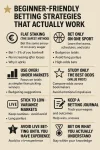
Strategy 1: Flat staking (make this your foundation)
Flat staking is boring in the best way. You bet the same unit size every time, because the biggest beginner leak is not a bad pick, it is emotional staking. A win makes you feel smarter than you are. A loss makes you feel like you need to respond immediately. Flat staking blocks both.Keep the unit small enough that losses do not make you panic. You want a stake size that lets you think clearly after a defeat, not one that makes you reach for “one more bet to fix it”. Many beginners do well with a single base unit for almost everything. If you occasionally increase to 2 units, it should be because the price is genuinely better than your usual opportunities, not because you are excited.
The payoff is that your results become readable. When stake sizes are consistent, you can tell whether you are improving or just swinging around on variance.
Strategy 2: One-sport focus (depth beats hopping around)
Most beginners lose money by trying to bet everything in front of them. Not because every sport is impossible, but because constant switching keeps you shallow. You never build a feel for what is normal, so you cannot recognize when a price is off, when news matters, or when a “sharp move” is actually nothing.Picking one main sport for a while does two things. First, it reduces the number of decisions you have to make, which reduces mistakes. Second, it creates compounding learning: you start noticing patterns in team styles, schedules, injuries, and how the market reacts. That is where real confidence comes from, not from a good weekend.
If you want progress that lasts, one sport for a few months beats ten sports for one weekend each.
Strategy 3: Keep your market menu small (simplicity is an edge)
Beginners rarely lose because they chose the “wrong side”. They lose because they choose markets they do not fully understand, then they cannot review the decision properly after it loses. This is how you end up repeating the same mistake with different packaging.A small market menu fixes that. You pick a few core markets you understand well, then you get better at reading the situations where those markets make sense. You are not trying to become a market tourist. You are trying to become competent.
In football, the beginner-friendly idea is simple: use markets where you can clearly explain what you need to happen and why the price makes sense. The better you can explain it, the easier it is to spot when you are forcing a bet.
Strategy 4: Lower-variance choices when you are unsure (insurance beats ego)
A classic beginner mistake is treating uncertainty like a challenge. You feel a match is close, but you still want a big payout, so you take the riskier option and hope your “instinct” is right. The end result is usually big swings that trigger chasing and bad decisions.A calmer approach is to match your bet to your confidence level. When your read is only slightly strong, it makes sense to choose a lower-variance option instead of pretending you have a massive edge. That is not fear. That is accurate self-assessment, which is one of the most underrated skills in betting.
The fastest way to ruin a decent process is turning small edges into huge emotional stakes.
Strategy 5: Price first (the easiest value habit)
You do not need advanced models to benefit from thinking in price terms. The beginner version is straightforward: you are not “backing a team”, you are buying a number. If you can get a better number for the same idea, you should.This habit alone improves your results without changing your picks. It also changes your mindset. Instead of asking, “Who wins?”, you start asking, “Is this price fair for what I think happens?”. And if you cannot answer that clearly, passing becomes easier because you do not feel like you are missing a “sure thing”. You feel like you are avoiding a bad purchase.
Strategy 6: Delay live betting until you have control
Live betting is where discipline goes to die, because the speed creates urgency. You see a chance, you feel late, you click quickly, and the reasoning happens after the bet instead of before it. Beginners often confuse this with skill because it feels like “reacting”.If you are still building self-control, pre-match betting is safer because it forces you to slow down. If you do live bet, treat it like a tool you use rarely: smaller stake, simple market, and only when you can explain why the price is an overreaction to what you saw.
If your reason is “it feels like a goal”, that is not analysis. That is your brain asking for dopamine.
Strategy 7: Keep a betting journal (so you improve instead of repeating)
If you do not track your bets, you are trying to improve with a distorted memory. You will remember the dramatic wins, forget the ugly mistakes, and slowly build opinions that are not supported by your actual results.You do not need a complex spreadsheet. You need consistency. Record the market, odds, stake in units, and one sentence about why you placed it. That one sentence is the key, because later you can judge whether you were disciplined or just lucky.
After a few weeks, your journal starts telling you uncomfortable truths in a helpful way: which markets you understand, which situations you misread, and whether your confidence matches reality.
Strategy 8: Only bet what you understand (boredom is a hidden enemy)
A lot of beginner losses are not “bad analysis”. They are boredom bets, FOMO bets, and “I want action” bets. That is why it feels like you were doing fine and then suddenly everything went wrong. The drift is usually emotional, not technical.If you cannot explain the league, the teams, and why the price is wrong, you are not making a bet. You are pressing buttons. Staying inside your knowledge zone is not limiting. It is what keeps your process stable long enough to expand later.
Beginner traps to watch for (how rules quietly disappear)
The most common failure mode is not one awful bet. It is a slow slide. You start with rules, then you bend them a little, then you bend them again because “this one is special”, and suddenly you are back to gambling.A few warning signs show up again and again: parlays becoming your default “strategy”, staking changing mid-session, adding extra matches because you are bored, and jumping to a new approach after a normal losing streak. None of these feel dramatic in the moment, but they change your results more than any single pick.
Progress for beginners is not finding a secret strategy. It is repeating simple rules long enough that your edge can show up. Discipline beats flash, and it usually wins quietly.
A simple beginner plan you can actually follow
If you want one clean plan, keep it practical: flat stake small units, focus on one sport, stick to a small market menu you understand, compare prices before you commit, track every bet, and avoid live betting unless you are calm and selective.It will feel boring. That is not a problem. Boring is what keeps your bankroll alive while your skill catches up.
Checklist (quick version)
- Is my stake the same unit size I use on a normal day?
- Can I explain why this bet is good in one sentence?
- Am I placing this because I have an edge, or because I want action?
- If I lose, will I accept it without immediately betting again?
- Will I still like this decision tomorrow when emotions are gone?
FAQ
Q1: What is the safest beginner strategy overall?Flat staking with small units. It protects you from variance and emotional stake changes.
Q2: When can I start using more advanced approaches?
When you have a tracked sample and your staking does not drift with mood. If your “strategy” changes every week, you are not ready.
Q3: Are parlays ever okay for beginners?
Yes, but treat them as occasional entertainment, not your main approach. Your serious progress usually comes from disciplined singles and clean decision-making.
Next in Beginner Series: The Psychology of Betting (Beginner Edition)
Previous: Beginner’s Guide to Live Betting
Attachments
Last edited:

 Beginner Betting Guides - Reference Menu


